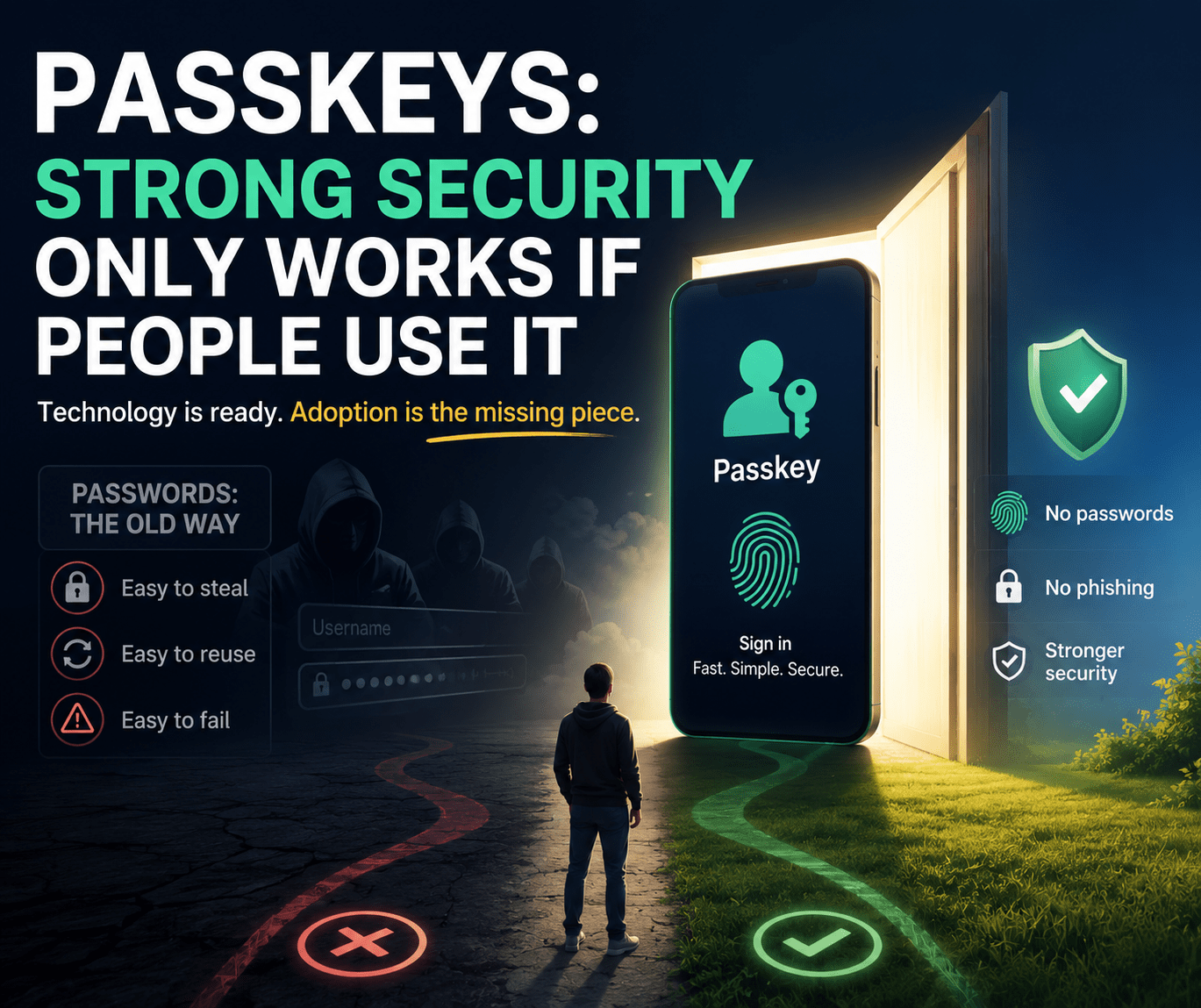
Passkeys are meant to replace passwords. Instead of typing a password, you log in using your fingerprint, face scan, or device unlock. Behind the scenes, your device proves who you are using secure cryptography.
Sounds great. And it is. But there’s a problem.
The real issue is not the tech
Passkeys are secure by design. They are much harder to steal than passwords. You cannot easily phish them or reuse them across sites.
But security does not depend on how good the technology is. It depends on whether people actually use it.
And right now, adoption is the weak point.
Why passkeys are better than passwords
Passwords are messy:
- People reuse them everywhere
- They are easy to guess or steal
- They get leaked in data breaches all the time
Passkeys fix this:
- No password to remember
- Nothing to type
- Nothing to reuse or steal
- Each login is tied to your device securely
So in theory, passkeys should reduce hacks massively.
So why isn’t everyone using them?
This is where reality kicks in.
- People don’t like change
Most users are used to passwords. Even if passwords are bad, they feel familiar. - Confusion during setup
Passkeys can feel unclear. People don’t understand where their login is stored or what happens if they lose their device. - Not all websites support it
Some big platforms support passkeys, but many still don’t. So users fall back to passwords anyway. - Backup concerns
People worry: “What if I lose my phone?”
Even though recovery options exist, users don’t always trust them.
The real risk
If only a small group uses passkeys, hackers will ignore them and keep attacking password users.
That means:
- Security improves for some people
- But attackers still succeed overall
- The system does not fully get safer
So passkeys only reach their full potential if they become mainstream.
What needs to happen
To make passkeys actually work at scale:
- Big platforms must push them by default
- Users need simple onboarding, not technical explanations
- Backup and recovery must feel obvious and safe
- Passwords should slowly disappear, not stay as a fallback forever
Bottom line
Passkeys are not a weak technology problem. They are a human adoption problem.
The security improvement is already here. The missing piece is behavior.
Until people actually switch, passwords will keep failing us in the same old ways.
 Salman Tariq
 SalmanTechBlogs
Leave a comment